
 加载中…
加载中…[转载]心率计算/Maximum Heart Rate--2012年03月03日
 (2017-04-20 21:32:48)
标签:
转载 |
分类: 知识加油站 |
|
心率计算/Maximum Heart Rate |
计算您的心率/Maximum Heart Rate equals:
|
(Age 30 or below) |
220 - age/年岁 |
|
(Age above 30) |
190 - (age/年岁-30)/2 |
It is important to understand
that this is an approximation, as each of us is biochemically
unique. It is, however, a good starting point. Apart from the fact
that we are all different, there are a number of other factors that
impact upon our
-
The type of sport: The above calculations relate to running. MHR for swimming and cycling may be lower by 5 to 10 bps.
-
Your level of Activity: When you are younger high levels of activity tend to lower your maximum heart rate, however as you get older (over 50) a history of strong training usually results in your ability to maintain your MHR at slightly higher levels
-
Sex: Females tend to have a higher MHR then males
To establish your actual MHR you should do a properly supervised test.
Resting Heart Rate (RHR)
Why is it important to know
your MHR? Knowing your MHR, and your RHR (resting heart rate) is
essential if you wish to train effectively. Stretching between our
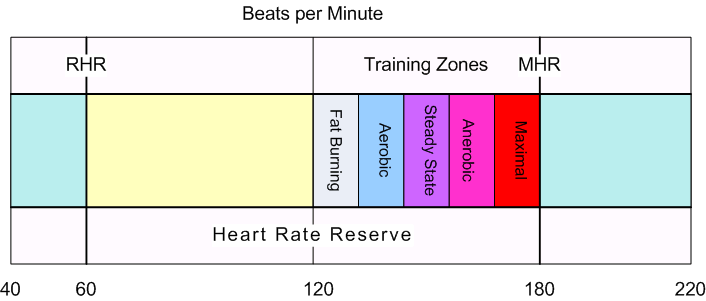
MHR and our RHR is our Heart Rate Reserve(HRR).
|
Where and how often we place ourselves in this heart rate reserve will determine our fitness improvements. You obtain different benefits as you progress through the different subzones in your heart rate reserve. Before we talk about each of these subzones it is important to understand that they are approximations. One zone doesn't finish immediately a certain heart rate is reached. The zones tend to meld into one another. Real benefits from exercise tend to kick in as you move out of the bottom 50% of your heart rate reserve in into your training zones illustrated in the diagram above. Fat Burning/减肥 (50 to 60%)In this range you are developing your basic endurance and aerobic capacity. This zone is great for burning fat compared to the effort you put in. Other zones will also burn up your fat but you will have to work harder to burn up the same amount. |
|
Aerobic/有氧运动 (60 to 70%)
This zone is great for your cardiovascular system. This helps your muscles become stronger and more efficient and you develop your bodies ability to transport oxygen to (and carbon dioxide away from) your muscles. You should be spending the majority of your training time in this zone.
Steady State (70 to 80%)
Anaerobic/无氧运动 (80 to 90%)
Entering this zone is a sign that you have become serious about your sport. In this zone your body develops its ability to handle lactic acid. An anaerobic workout takes place when you are working so hard that your body cannot keep up with the production of fuel and oxygen and so you need to dip into your reserves. When you dip into your reserves you produce numerous waste products - principally lactic acid.
Maximal (over 90%)
Your Heart Rate Reserves and Training Zones
Step by Step Guide for Calculating Your Training Zones
-
What is your
Resting Heart Rate (RHR) What is your
Maximum Heart Rate (MHR) -
Heart Rate Reserve (HRR) equals MHR-RHR
-
Fat Burning Range(bottom)=RHR+hrr*.5
-
Example
RHR 60
MHR 180
HRR=180-60=120
Fat Burning Range(bottom)=60+(120*50%)=120 bps
喜欢
0
赠金笔