| http://upload.wikimedia.org/wikipedia/commons/thumb/8/84/Martin_Luther_King_Jr_NYWTS.jpg/250px-Martin_Luther_King_Jr_NYWTS.jpg |
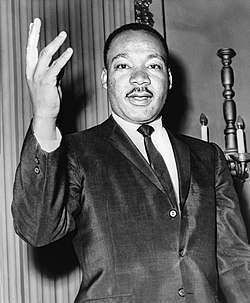
Martin Luther King, Jr. (January 15,
1929 – April 4, 1968) was an African American clergyman, activist and prominent leader in the
American
civil rights movement. His
main legacy was to secure progress on civil
rights in the United States and he is frequently
referenced as a human
rights icon today.
A
Baptist minister,[1]
King became a civil rights activist early in his career. He led the
1955
Montgomery Bus Boycott and helped found
the
Southern Christian Leadership Conference
in 1957, serving as its first president.
|
|
King's efforts led to the 1963
March on Washington, where
King delivered his “I
Have a Dream” speech. There, he raised
public consciousness of the civil rights movement and established
himself as one of the greatest orators in U.S. history.
In 1964, King became the youngest person to
receive the Nobel Peace Prize for his work to
end racial segregation and
racial discrimination through
civil disobedience and other
non-violent means. By the time of his
death in 1968, he had refocused his efforts on ending poverty and
opposing the Vietnam War, both from a religious
perspective.
King was
assassinated on April 4,
1968, in Memphis, Tennessee. He was
posthumously awarded the
Presidential Medal of Freedom in 1977
and
Congressional Gold Medal in
2004.
|
Martin Luther King
Day
-
At the White
House Rose Garden on November 2, 1983,
President Ronald Reagan signed a bill creating
a federal holiday to honor King. Observed for the first time on
January 20, 1986, it is called
Martin Luther King, Jr. Day. Following
President George H. W. Bush's 1992
proclamation, the holiday is observed on the third Monday of
January each year, near the time of King's birthday.[182]
On January 17, 2000, for the first time, Martin Luther King Day was
officially observed in all fifty U.S.
states.[183]
|
 (2009-01-19 21:53:01)

 加载中…
加载中…