
 加载中…
加载中…Compactness and compact operator——紧性与紧算子
 (2013-03-12 11:00:26)
 1.紧集
定义
性质
直观理解
类似概念
In mathematics, a relatively compact subspace (or relatively compact subset) Y of a topological space X is a subset whose closure is compact.
Since closed subsets of a compact space are compact, every subset of a compact space is relatively compact. In the case of a metric topology, or more generally when sequences may be used to test for compactness, the criterion for relative compactness becomes that any sequence in Y has a subsequence convergent in X. Such a subset may also be called relatively bounded, or pre-compact, although the latter term is also used for a totally bounded subset. (These are equivalent in a complete space.)
Some major theorems characterise relatively compact subsets, in particular in function spaces. An example is the Arzelà–Ascoli theorem. Other cases of interest relate to uniform integrability, and the concept of normal family in complex analysis. Mahler's compactness theorem in the geometry of numbers characterises relatively compact subsets in certain non-compact homogeneous spaces (specifically spaces of lattices).
The definition of an almost periodic function F at a conceptual level has to do with the translates of F being a relatively compact set. This needs to be made precise in terms of the topology used, in a particular theory.
As a counterexample take any neighbourhood of the particular point of an infinite particular point space. The neighbourhood itself may be compact but is not relatively compact because its closure is the whole non-compact space.
from:http://en.wikipedia.org/wiki/Relatively_compact
3 紧算子compact operator
In functional analysis, a branch of mathematics, a compact operator is a linear operator L from a Banach space X to another Banach space Y, such that the image under L of any bounded subset of X is a relatively compact subset of Y. Such an operator is necessarily a bounded operator, and so continuous.
Any bounded operator L that has finite rank is a compact operator; indeed, the class of compact operators is a natural generalisation of the class of finite-rank operators in an infinite-dimensional setting. When Y is a Hilbert space, it is true that any compact operator is a limit of finite-rank operators, so that the class of compact operators can be defined alternatively as the closure in the operator norm of the finite-rank operators. Whether this was true in general for Banach spaces (the approximation property) was an unsolved question for many years; in the end Per Enflo gave a counter-example.
The origin of the theory of compact operators is in the theory of integral equations, where integral operators supply concrete examples of such operators. A typical Fredholm integral equation gives rise to a compact operator K on function spaces; the compactness property is shown by equicontinuity. The method of approximation by finite-rank operators is basic in the numerical solution of such equations. The abstract idea of Fredholm operator is derived from this connection.
Contents |
Equivalent formulations
A bounded operator T is compact if and only if any of the following is true
- Image of the unit ball in X under T is relatively compact in Y.
- Image of any bounded set under T is relatively compact in Y.
- Image of any bounded set under T is totally bounded in Y.
- there
exists a neighbourhood
of 0, http://upload.wikimedia.org/math/3/1/1/311e73f612cc0e0abdddafd76bc6a190.pngand
compact operator——紧性与紧算子" /> , and compact set http://upload.wikimedia.org/math/e/e/8/ee868239d2bc94bb3b3bfeb5571200bb.pngand compact operator——紧性与紧算子" /> such that http://upload.wikimedia.org/math/a/5/0/a5019b94d0d3b626c6c41b9890bf5675.pngand compact operator——紧性与紧算子" /> . - For any
sequence http://upload.wikimedia.org/math/8/e/6/8e663c17e7157439c69d89052637c0d2.pngand
compact operator——紧性与紧算子" /> from the unit ball in X, the sequence http://upload.wikimedia.org/math/8/4/3/84345202b3e9b5f5e8a94e8983909bff.pngand compact operator——紧性与紧算子" /> contains a Cauchy subsequence.


Note that if a linear operator is compact, then it is easy to see that it is bounded, and hence continuous.
Important properties
In the
following, X, Y, Z, W are Banach
spaces, B(X,

-
K(X,
Y) is a closed subspace of B(X, Y): Let Tn, n ∈ N, be a sequence of compact operators from one Banach space to the other, and suppose that Tn converges to T with respect to the operator norm. Then T is also compact.
-
http://upload.wikimedia.org/math/3/6/b/36b6360bd9979879cd7a9ad5e3913c35.pngand
compact operator——紧性与紧算子" /> In particular, K(X) forms a two-sided operator ideal in B(X).

- http://upload.wikimedia.org/math/7/a/2/7a2bfe9432905f0e9d29c62abdedb7db.pngand
compact operator——紧性与紧算子" /> is compact if and only if X has finite dimension.
- For any
T
∈ K(X), http://upload.wikimedia.org/math/9/3/5/9353057b2c637fff76e9e6890a8ab78a.pngand compact operator——紧性与紧算子" /> is a Fredholm operator of index 0. In particular, http://upload.wikimedia.org/math/9/0/e/90e3494f51c0e35ca96c04a2b3340417.pngand compact operator——紧性与紧算子" /> is closed. This is essential in developing the spectral properties of compact operators. One can notice the similarity between this property and the fact that, if M and N are subspaces of a Banach space where M is closed and N is finite dimensional, then M + N is also closed.


- Any compact operator is strictly singular, but not vice-versa.[1]
Origins in integral equation
theory
A crucial property of compact operators is the Fredholm alternative, which asserts that the existence of solution of linear equations of the form
http://upload.wikimedia.org/math/9/3/c/93c56361ba53c7bc8a3a7e1db4c33f5c.pngand

(where K is a compact operator, f is a given function, and u is the unknown function to be solved for) behaves much like as in finite dimensions. The spectral theory of compact operators then follows, and it is due to Frigyes Riesz (1918). It shows that a compact operator K on an infinite-dimensional Banach space has spectrum that is either a finite subset of C which includes 0, or the spectrum is a countably infinite subset of C which has 0 as its only limit point. Moreover, in either case the non-zero elements of the spectrum are eigenvalues of K with finite multiplicities (so that K − λI has a finite dimensional kernel for all complex λ ≠ 0).
An important example of a compact operator is compact embedding of Sobolev spaces, which, along with the Gårding inequality and the Lax–Milgram theorem, can be used to convert an elliptic boundary value problem into a Fredholm integral equation.[2] Existence of the solution and spectral properties then follow from the theory of compact operators; in particular, an elliptic boundary value problem on a bounded domain has infinitely many isolated eigenvalues. One consequence is that a solid body can vibrate only at isolated frequencies, given by the eigenvalues, and arbitrarily high vibration frequencies always exist.
The compact operators from a Banach space to itself form a two-sided ideal in the algebra of all bounded operators on the space. Indeed, the compact operators on a Hilbert space form a maximal ideal, so the quotient algebra, known as the Calkin algebra, is simple.
Compact operator on Hilbert spaces
An equivalent definition of compact operators on a Hilbert space may be given as follows.
An operator
http://upload.wikimedia.org/math/b/9/e/b9ece18c950afbfa6b0fdbfa4ff731d3.pngand


- http://upload.wikimedia.org/math/a/6/6/a66141ed2eb04c54eb1aef73efe83d85.pngand
compact operator——紧性与紧算子" />

is said to be compact if it can be written in the form
- http://upload.wikimedia.org/math/8/3/d/83d58de25d38acb3eb1cf646f6bc72a9.pngand
compact operator——紧性与紧算子" />

where
http://upload.wikimedia.org/math/4/4/3/443267df89e7a6de07a7b99920492c5f.pngand


- http://upload.wikimedia.org/math/e/0/1/e0112e2828a25c52da7ac6a55d5146b9.pngand
compact operator——紧性与紧算子" />

The bracket http://upload.wikimedia.org/math/e/0/2/e02eaeb6eb365f078ca029f67f7a6973.pngand

An important subclass of compact operators are the trace-class or nuclear operators.
Completely continuous operators
Let
X and Y be Banach spaces. A bounded linear operator
T


Examples
- For some fixed
g
∈ C([0, 1]; R), define the linear operator T by
-
- http://upload.wikimedia.org/math/a/c/5/ac5ad7a7399852e4098b256eb0bf76e2.pngand
compact operator——紧性与紧算子" />
- http://upload.wikimedia.org/math/a/c/5/ac5ad7a7399852e4098b256eb0bf76e2.pngand
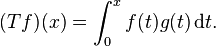
- That the operator T is indeed compact follows from the Ascoli theorem.
- More
generally, if Ω is any domain in Rn and
the integral kernel
k
: Ω × Ω → R is a Hilbert—Schmidt kernel, then the operator T on L2(Ω; R) defined by
-
- http://upload.wikimedia.org/math/2/a/d/2ad8cf35dce9a4eb2c201f8ca3aabe60.pngand
compact operator——紧性与紧算子" />
- http://upload.wikimedia.org/math/2/a/d/2ad8cf35dce9a4eb2c201f8ca3aabe60.pngand

- is a compact operator.
- By Riesz's lemma, the identity operator is a compact operator if and only if the space is finite dimensional.
See
also
- Spectral theory of compact operators
- Fredholm operator
- Fredholm integral equations
- Fredholm alternative
- Compact embedding
- Strictly singular operator
Notes
- ^ N.L. Carothers, A Short Course on Banach Space Theory, (2005) London Mathematical Society Student Texts 64, Cambridge University Press.
- ^ William McLean, Strongly Elliptic Systems and Boundary Integral Equations, Cambridge University Press, 2000
References
-
Conway, John B. (1985). A
course in functional analysis. Springer-Verlag. ISBN
3-540-96042-2
-
Renardy, Michael and Rogers,
Robert C. (2004). An introduction to partial differential
equations. Texts in Applied Mathematics 13 (Second ed.). New
York: Springer-Verlag. p.
356. ISBN (Section 7.5)0-387-00444-0.
-
Kutateladze, S.S. (1996).
Fundamentals of Functional Analysis. Texts in Mathematical
Sciences 12 (Second ed.). New York: Springer-Verlag.
p.
292. ISBN 978-0-7923-3898-7.
喜欢
0
赠金笔