
 加载中…
加载中…科技日报--地球内核振荡导致一天的长短变化
 (2022-06-20 14:23:49)
标签:
科技日报地核震荡 |
分类: 翻译 |
题记:看到地球的这张图片,让我想起了俄罗斯的套娃;但地球内部最小的套娃---地球内核,竟然是“一个与冥王星大小相当的炽热、致密的实心铁球”。而且,它的运动速度和方向能决定地球的时空变化!“内核是地球最热的部分,大约 10,000°F (5400°C),与太阳表面的温度相近!”地核,就相当于地球的心脏,它时刻跳动、热血沸腾且激情澎湃,地球在宇宙中的运行,本身就是诗篇,就是交响……..
New Research Shows the Earth’s Inner Core Oscillates – Causes Variation in the Length of a Day
新研究表明地球内核振荡导致一天的长短变化
https://scitechdaily.com/images/Earth-Core-Structure.jpg?ezimgfmt=ng:webp/ngcb1/rs:device/rscb1-1

Scientists have
discovered evidence that the Earth’s inner core oscillates,
contradicting previously held beliefs that it consistently rotates
at a faster rate than the planet’s surface.
科学家们发现了地球内核振荡的证据,这与以前认为的地球内核一直以比地球表面更快的速度旋转的理念相矛盾。
Scientists identify
a six-year cycle of super- and sub-rotation that affected the
length of a day based on their analysis of seismic
data.
科学家根据他们对地震数据的分析确定了影响一天长度的六年超转和亚转周期。
Earth’s structure is
divided into layers, with the inner core at the center followed by
the outer core, lower mantle, upper mantle, crust, and atmosphere.
The inner core is the hottest part of the planet at about 10,000 °F
(5400 °C), which is similar to the temperature of the surface of
the sun!
地球的结构分为几层,内核位于中心,然后是外核、下地幔、上地幔、地壳和大气。 内核是地球最热的部分,大约 10,000°F
(5400°C),与太阳表面的温度相近!
Believed to consist
mostly of an iron-nickel alloy, the inner core is mainly a solid
ball with a radius of about 760 miles (1,220 km). It rotates
slightly faster than the planet as a while, which is called
super-rotation.
内核被认为主要由铁镍合金组成,是一个半径约为 760 英里(1,220
公里)的实心球。它的自转速度比行星稍快一些,称为超自转。
University of
Southern California (USC) scientists have found evidence that the
Earth’s inner core oscillates, contradicting previously accepted
models that suggested it consistently rotates at a faster rate than
the planet’s surface.
南加州大学 (USC)
的科学家发现了地球内核振荡的证据,这与先前接受的模型相矛盾,该模型表明它始终以比地球表面更快的速度旋转。
Their study,
published today (June 10, 2022) in the journal Science Advances,
shows that the inner core changed direction in the six-year period
from 1969-74, according to the analysis of seismic data. The
scientists say their model of inner core movement also explains the
variation in the length of a day, which has been shown to oscillate
persistently for the past several decades.
他们的研究于今天(2022 年 6 月
10 日)发表在《科学进展》杂志上,根据对地震数据的分析,表明内核在 1969---74 年的六年期间改变了方向。
科学家们说,他们的内核运动模型也解释了一天长度的变化,在过去的几十年里,这一变化已被证明是持续振荡的。
“From our findings,
we can see the Earth’s surface shifts compared to its inner core,
as people have asserted for 20 years,” said John E. Vidale,
co-author of the study and Dean’s Professor of Earth Sciences at
USC Dornsife College of Letters, Arts and Sciences. “However, our
latest observations show that the inner core spun slightly slower
from 1969-71 and then moved the other direction from 1971-74. We
also note that the length of a day grew and shrank as would be
predicted.
“根据我们的研究结果,我们可以看到地球表面与其内核相比发生了变化,正如人们 20
年来所断言的那样,”该研究的合著者、文学艺术及科学南加州大学多恩西夫学院地球科学系教授约翰•E•维代尔 (John E.
Vidale) 说。“然而,我们最新的观察表明,内核从 1969-71 年开始旋转稍微慢一些,然后从 1971-74
年开始向另一个方向移动。我们还注意到,一天的长度会像预期的那样增加和减少。
“The coincidence of
those two observations makes oscillation the likely
interpretation.”
“这两个观察结果的巧合使振荡成为可能的解释。”
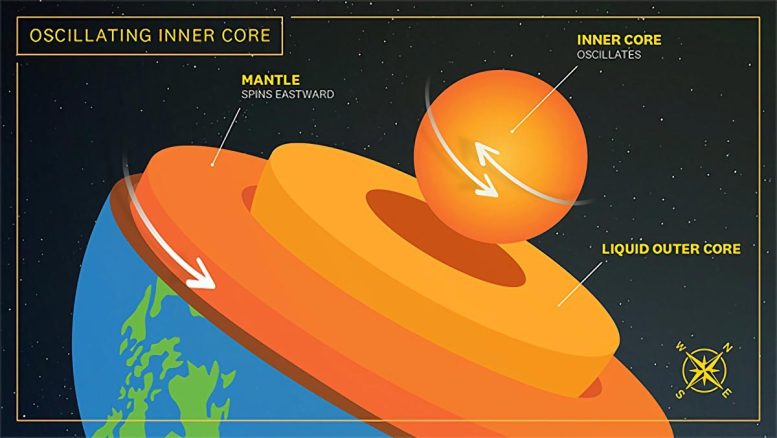
USC researchers
identified a six-year cycle of super- and sub-rotation in the
Earth’s inner core, contradicting previously accepted models that
suggested it consistently rotates at a faster rate than the
planet’s surface. Credit: Edward Sotelo/USC
南加州大学的研究人员确定了地球内核的超自转和超自转周期为六年,这与先前接受的模型相矛盾,该模型表明它始终以比地球表面更快的速度自转。图片来源:爱德华•索特洛/南加州大学
Analysis of atomic
tests pinpoints rotation rate and direction
Our understanding of
the inner core has expanded dramatically in the past 30 years. The
inner core — a hot, dense ball of solid iron the size of Pluto —
has been shown to move and/or change over decades. It’s also
impossible to observe directly, meaning researchers struggle
through indirect measurements to explain the pattern, speed and
cause of the movement and changes.
原子测试分析精确定位旋转速率和方向
在过去的 30
年里,我们对内核的理解急剧扩展。内核,一个与冥王星大小相当的炽热、致密的实心铁球,已被证明会在数十年内移动和/或发生变化。直接观察也是不可能的,这意味着研究人员很难通过间接测量来解释运动和变化的模式、速度和原因。
Research published
in 1996 was the first to propose that the inner core rotates faster
than the rest of the planet — also known as super-rotation — at
roughly 1 degree per year. Subsequent findings from Vidale
reinforced the idea that the inner core super-rotates, albeit at a
slower rate.
1996
年发表的研究首次提出内核的旋转速度比地球其他部分快,也称为超级自转,每年大约 1 度。 Vidale
的后续发现强化了内核超旋转的观点,尽管速度较慢。
Earth’s layers and
structure.
Utilizing data from
the Large Aperture Seismic Array (LASA), a U.S. Air Force facility
in Montana, researcher Wei Wang and Vidale found the inner core
rotated slower than previously predicted, approximately 0.1 degrees
per year. The study analyzed waves generated from Soviet
underground nuclear bomb tests from 1971-74 in the Arctic
archipelago Novaya Zemlya using a novel beamforming technique
developed by Vidale.
地球的层次和结构。
利用来自美国蒙大拿州空军设施大孔径地震阵列(LASA)的数据,研究员 Wei Wang 和 Vidale
发现内核的旋转速度比之前预测的要慢,大约每年 0.1 度。 该研究使用 Vidale 开发的新型波束成形技术分析了 1971-74
年在北极群岛新地岛进行的苏联地下核弹试验产生的波。
The new findings
emerged when Wang and Vidale applied the same methodology to a pair
of earlier atomic tests beneath Amchitka Island at the tip of the
Alaskan archipelago — Milrow in 1969 and Cannikin in 1971.
Measuring the compressional waves resulting from the nuclear
explosions, they discovered the inner core had reversed direction,
sub-rotating at least a tenth of a degree per
year.
当 Wang 和 Vidale
将相同的方法应用于阿拉斯加群岛(1969 年的 Milrow 和 1971 年的 Cannikin)尖端的 Amchitka
岛下方的一对早期原子试验时,新的发现出现了。测量核爆炸产生的压缩波,他们发现内核的方向相反,每年至少副旋转十分之一度。
This latest study
marked the first time the well-known six-year oscillation had been
indicated through direct seismological
observation.
这项最新研究标志着首次通过直接地震观测表明了著名的六年振荡。
“The idea the inner
core oscillates was a model that was out there, but the community
has been split on whether it was viable,” Vidale says. “We went
into this expecting to see the same rotation direction and rate in
the earlier pair of atomic tests, but instead we saw the opposite.
We were quite surprised to find that it was moving in the other
direction.”
“内核振荡的想法是一个已经存在的模型,但研究界对于它是否可行存在分歧,”维代尔说。“我们进行这项工作时期望在前一对原子测试中看到相同的旋转方向和速率,但相反我们看到了相反的结果。我们很惊讶地发现它正朝着另一个方向发展。”
Future research to
dig deeper into why inner core formed
Vidale and Wang both
noted future research would depend on finding sufficiently precise
observations to compare against these results. By using
seismological data from atomic tests in previous studies, they have
been able to pinpoint the exact location and time of the very
simple seismic event, says Wang. However, the Montana LASA closed
in 1978 and the era of U.S. underground atomic testing is over,
meaning that the researchers would need to rely on comparatively
imprecise earthquake data, even with recent advances in
instrumentation.
未来的研究将深入挖掘内核形成的原因
Vidale 和 Wang
都指出,未来的研究将取决于找到足够精确的观察结果来与这些结果进行比较。王说,通过在以前的研究中使用来自原子测试的地震学数据,他们已经能够查明非常简单的地震事件的确切位置和时间。然而,蒙大拿州
LASA 于 1978
年关闭,美国地下原子测试的时代已经结束,这意味着研究人员需要依赖相对不精确的地震数据,即使仪器最近取得了进展。
The study does
support the speculation that the inner core oscillates based on
variations in the length of day — plus or minus 0.2 seconds over
six years — and geomagnetic fields, both of which match the theory
in both amplitude and phase. Vidale says the findings provide a
compelling theory for many questions posed by the research
community.
该研究确实支持这样的推测,即内核根据白天长度的变化(在六年内正负 0.2 秒)和地磁场的变化,两者在幅度和相位上都与理论相匹配。
Vidale 说,这些发现为研究界提出的许多问题提供了一个令人信服的理论。
“The inner core is
not fixed — it’s moving under our feet, and it seems to going back
and forth a couple of kilometers every six years,” Vidale said.
“One of the questions we tried to answer is, does the inner core
progressively move or is it mostly locked compared to everything
else in the long term? We’re trying to understand how the inner
core formed and how it moves over time — this is an important step
in better understanding this process.”
“内核不是固定的,它在我们脚下移动,它似乎每六年来回移动几公里,”维代尔说。
“我们试图回答的一个问题是,从长远来看,与其他一切相比,内核是逐渐移动还是大部分锁定?
我们正试图了解内核是如何形成的,以及它是如何随着时间的推移而移动的,这是更好地理解这一过程的重要一步。”
喜欢
0
赠金笔