
 加载中…
加载中…科技日报--细菌酶(上)
 (2022-06-04 10:02:37)
标签:
科技日报细菌酶杂谈 |
分类: 翻译 |
题记:或许,在未来人类需要细菌酶来解决碳转换以及碳中和、碳储存的问题;世界上的事情真是奇妙,这如此庞大的碳军团最终却要被微乎其微的细菌所打败了。看来,大小和强弱并不是取胜的绝对关键;拥有技巧,也可以说是智慧才是硬道理。
细菌酶将二氧化碳转化为碳化合物的速度比光合作用快 20 倍,这回大自然要输给小细菌了,实际上,也算是大自然的胜利,因为细菌也是大自然的一部分。
小小的细菌也可以充当人类的老师,微生物的奇妙和神奇永远值得人类敬畏和仰止;尽管它们一直陪伴和参与人类生命的繁衍和进化,但人类对于它们的了解依然是屈指可数。
我相信,在未来,人类的某些奇迹和成就一定要依赖于它们的帮助和引导。
Bacterial Enzyme Converts CO2 Into Carbon Compounds 20x Faster Than Photosynthesis
细菌酶将二氧化碳转化为碳化合物的速度比光合作用快 20 倍
https://scitechdaily.com/images/SLAC-Enzyme-Visuals.jpeg?ezimgfmt=ng:webp/ngcb1/rs:device/rscb1-1
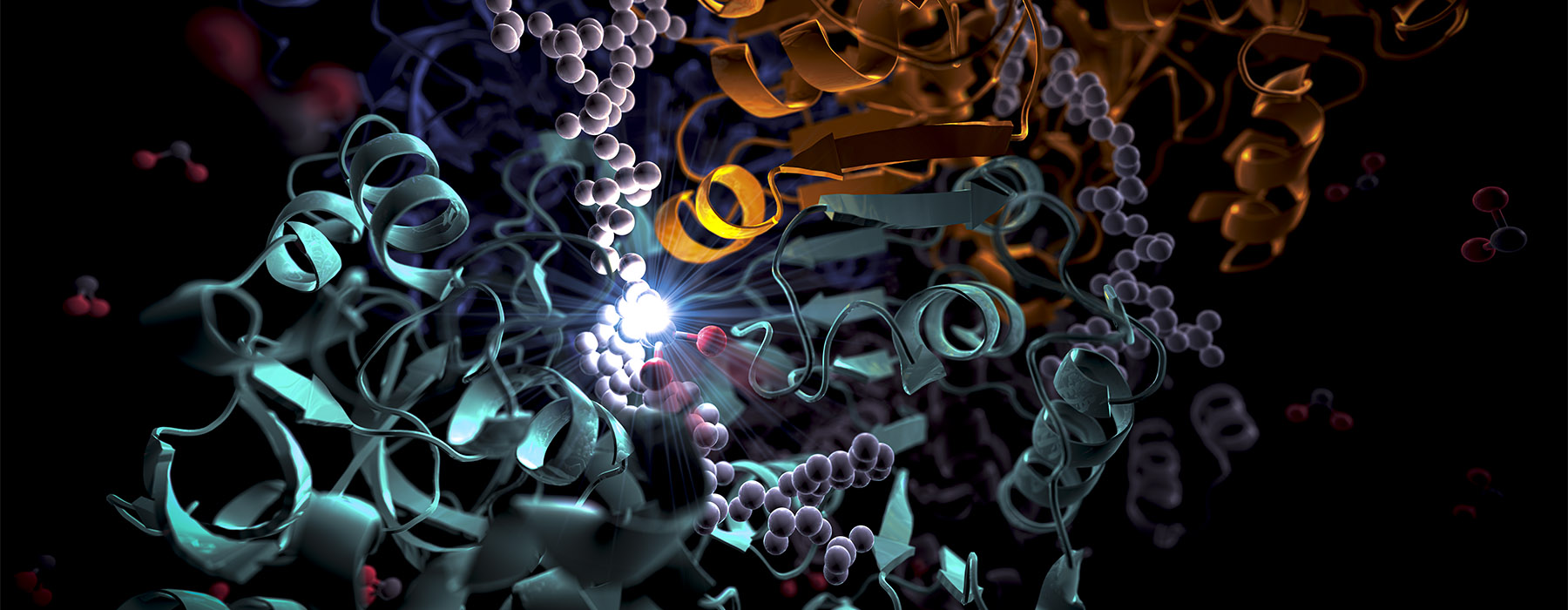
Artist interpretation of the enzyme Credit: SLAC National Accelerator Laboratory
艺术家对酶的解读 图片来源:SLAC国家加速器实验室
Researchers discover that a spot of molecular glue and a timely twist help a bacterial enzyme convert carbon dioxide into carbon compounds 20 times faster than plant enzymes do during photosynthesis. The results stand to accelerate progress toward converting carbon dioxide into a variety of products.
研究人员发现,在光合作用过程中,少量的分子胶和适时的扭曲帮助细菌酶将二氧化碳转化为碳化合物的速度比植物酶快 20 倍;这将加速将二氧化碳转化为各种产品的进程。
Carbon fixation, or the conversion of carbon dioxide from the air into carbon-rich biomolecules, is essential for plants’ survival. That’s the whole point of photosynthesis, and a cornerstone of the vast interlocking system that cycles carbon through plants, animals, microbes, and the atmosphere to sustain life on Earth.
碳固定,或将空气中的二氧化碳转化为富含碳的生物分子,对于植物的生存至关重要。这就是光合作用的全部意义所在,也是庞大的连锁系统的基石,该系统使碳在植物、动物、微生物和大气中循环以维持地球上的生命。
The carbon-fixing champs, however, are soil bacteria, not plants. Scientists may be able to develop artificial photosynthesis to convert greenhouse gas into fuels, fertilizers, antibiotics, and other products if they can figure out how certain bacterial enzymes carry out a vital step in carbon fixation 20 times quicker than plant enzymes.
然而,固碳冠军是土壤细菌,而不是植物。如果科学家们能够弄清楚某些细菌酶在碳固定中的关键步骤是如何比植物酶快 20 倍,那么他们或许能够开发出人工光合作用,将温室气体转化为燃料、肥料、抗生素和其他产品。
Now a team of researchers from the
现在,来自能源部 SLAC 国家加速器实验室、斯坦福大学、德国马克斯普朗克陆地微生物研究所、美国能源部联合基因组研究所 (JGI) 和智利康塞普西翁大学的一组研究人员发现了一种细菌酶,一种分子促进化学反应的机器,加速完成的这一壮举。
Rather than grabbing carbon dioxide molecules and attaching them to biomolecules one at a time, they found that this enzyme consists of pairs of molecules that work in sync, like the hands of a juggler who simultaneously tosses and catches balls to get the job done faster. One member of each enzyme pair opens wide to catch a set of reaction ingredients while the other closes over its captured ingredients and carries out the carbon-fixing reaction; then, they switch roles in a continual cycle.
他们发现这种酶不是一次抓住二氧化碳分子并将它们连接到生物分子上,而是由一对同步工作的分子组成,就像杂耍者的双手同时抛球和接球以更快地完成工作。每对酶的一个成员张开以捕获一组反应成分,而另一个成员则关闭其捕获的成分并进行固碳反应;
然后,他们在一个连续的循环中转换角色。
A
single spot of molecular “glue” holds each pair of enzymatic hands
together so they can alternate opening and closing in a coordinated
way, the team discovered, while a twisting motion helps hustle
ingredients and finished products in and out of the pockets where
the reactions take place. When both glue and twist are present, the
carbon-fixing reaction goes 100 times faster than without
them.
研究小组发现,一块分子“胶”将每一对酶的手固定在一起,这样它们就可以以协调的方式交替打开和关闭,而一个扭曲的运动有助于推动成分和成品进出反应发生的口袋。 当胶水和扭曲都存在时,碳固定反应比没有它们时快 100 倍。
https://scitechdaily.com/images/ECR-Enzyme-SLAC.gif
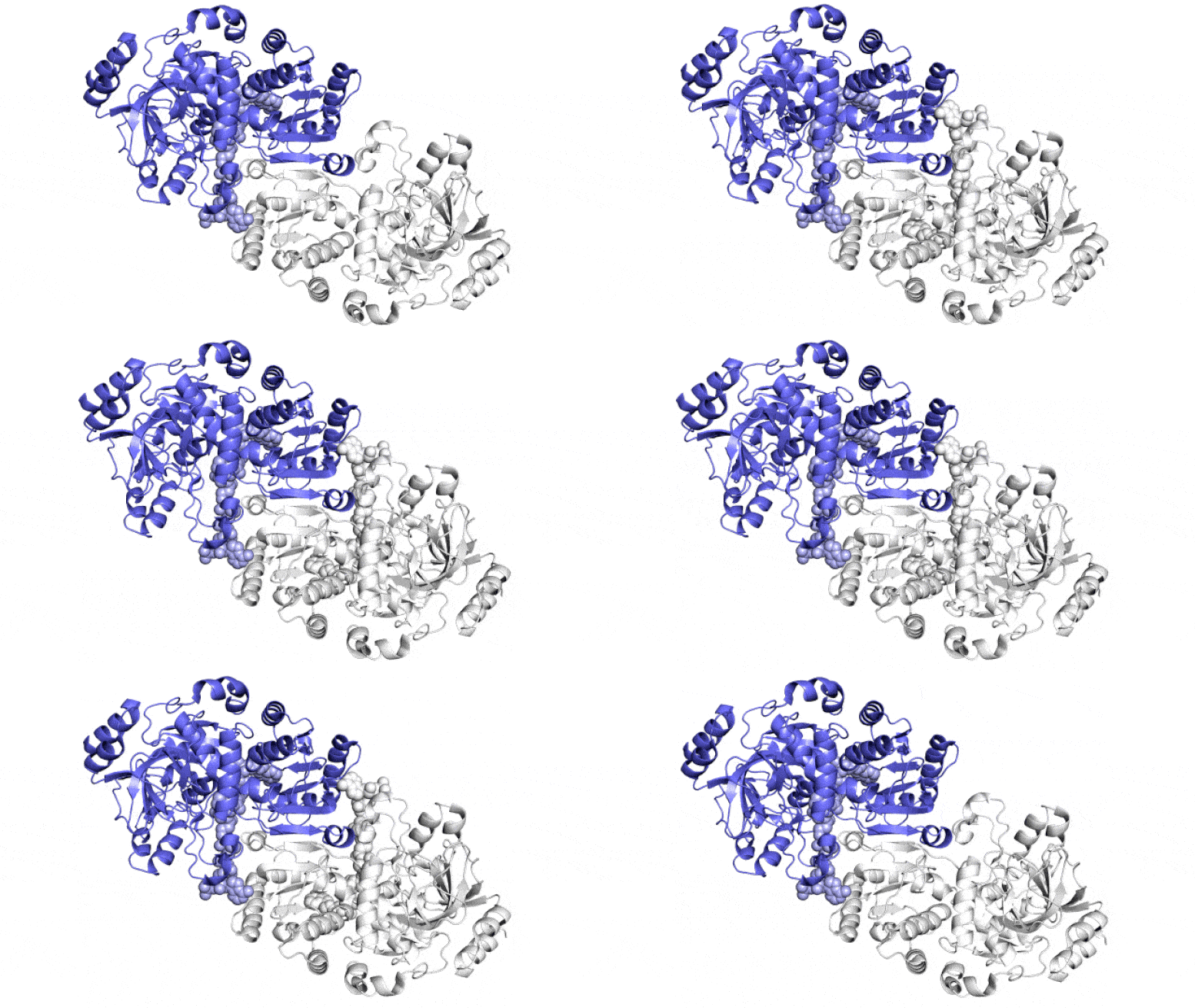
This animation shows two of the paired molecules
(blue and white) within the ECR enzyme, which fixes carbon in soil
microbes, in action. They work together, like the hands of a
juggler who simultaneously tosses and catches balls, to get the job
done faster. One member of each enzyme pair opens wide to catch a
set of reaction ingredients (shown coming in from top and bottom)
while the other closes over its captured ingredients and carries
out the carbon-fixing reaction; then, they switch roles in a
continual cycle. Scientists are trying to harness and improve these
reactions for artificial photosynthesis to make a variety of
products. Credit: H. DeMirci et
al.,
“This bacterial enzyme is the most efficient carbon fixer that we know of, and we came up with a neat explanation of what it can do,” said Soichi Wakatsuki, a professor at SLAC and Stanford and one of the senior leaders of the study, which was published in ACS CENTRAL SCIENCE this week.
“这种细菌酶是我们所知道的最有效的碳固剂,我们对它的作用提出了一个简洁的解释,”SLAC 和斯坦福大学教授、该研究(已发表在本周的ACS CENTRAL SCIENCE上)的高级领导者之一 Soichi Wakatsuki 说。
“Some of the enzymes in this family act slowly but in a very specific way to produce just one product,” he said. “Others are much faster and can craft chemical building blocks for all sorts of products. Now that we know the mechanism, we can engineer enzymes that combine the best features of both approaches and do a very fast job with all sorts of starting materials.”
“这个家族中的一些酶作用缓慢,但以一种非常特殊的方式只生产一种产品,”他说。“其他酶的速度要快得多,可以为各种产品制作化学构件。既然我们知道了机制,我们就可以设计出结合了两种方法的最佳特性的酶,并且可以非常快速地处理各种起始材料。”
IMPROVING ON NATURE
The enzyme the team studied is part of a family called enoyl-CoA carboxylases/reductases, or ECRs. It comes from soil bacteria called Kitasatospora setae, which in addition to their carbon-fixing skills can also produce antibiotics.
改善自然
该团队研究的酶是烯酰辅酶A羧化酶/还原酶或ECRs家族的一部分。它来自一种叫做 Kitasatospora setae 的土壤细菌,它们除了具有固碳能力外,还可以产生抗生素。
Wakatsuki heard about this enzyme family half a dozen years ago from Tobias Erb of the Max Planck Institute for Terrestrial Microbiology in Germany and Yasuo Yoshikuni of JGI. Erb’s research team had been working to develop bioreactors for artificial photosynthesis to convert carbon dioxide (CO2) from the atmosphere into all sorts of products.
六年前,Wakatsuki 从德国马克斯普朗克陆地微生物研究所的 Tobias Erb 和 JGI 的 Yasuo Yoshikuni 那里听说了这个酶家族。 Erb 的研究团队一直致力于开发用于人工光合作用的生物反应器,将大气中的二氧化碳 (CO2) 转化为各种产品。
As important as photosynthesis is to life on Earth, Erb said, it isn’t very efficient. Like all things shaped by evolution over the eons, it’s only as good as it needs to be, the result of slowly building on previous developments but never inventing something entirely new from scratch.
Erb 说,尽管光合作用对地球上的生命很重要,但它的效率并不高。就像亘古以来进化所塑造的所有事物一样,它只是尽可能好,这是在先前发展的基础上缓慢构建的结果,但从未从头开始发明全新的东西。
喜欢
0
赠金笔